
When air quality is poor here, stay indoors with windows shut and air conditioning on recirculate, keep rescue inhalers within reach, and postpone outdoor exercise. If you have asthma, COPD, or heart disease, check the Air Quality Index the way you check the temperature. And if you develop a cough with fatigue that drags on for weeks and does not respond to antibiotics, ask specifically about Valley fever — it is common here and frequently missed.
We have three distinct air problems, and they arrive in different seasons.
What we actually breathe
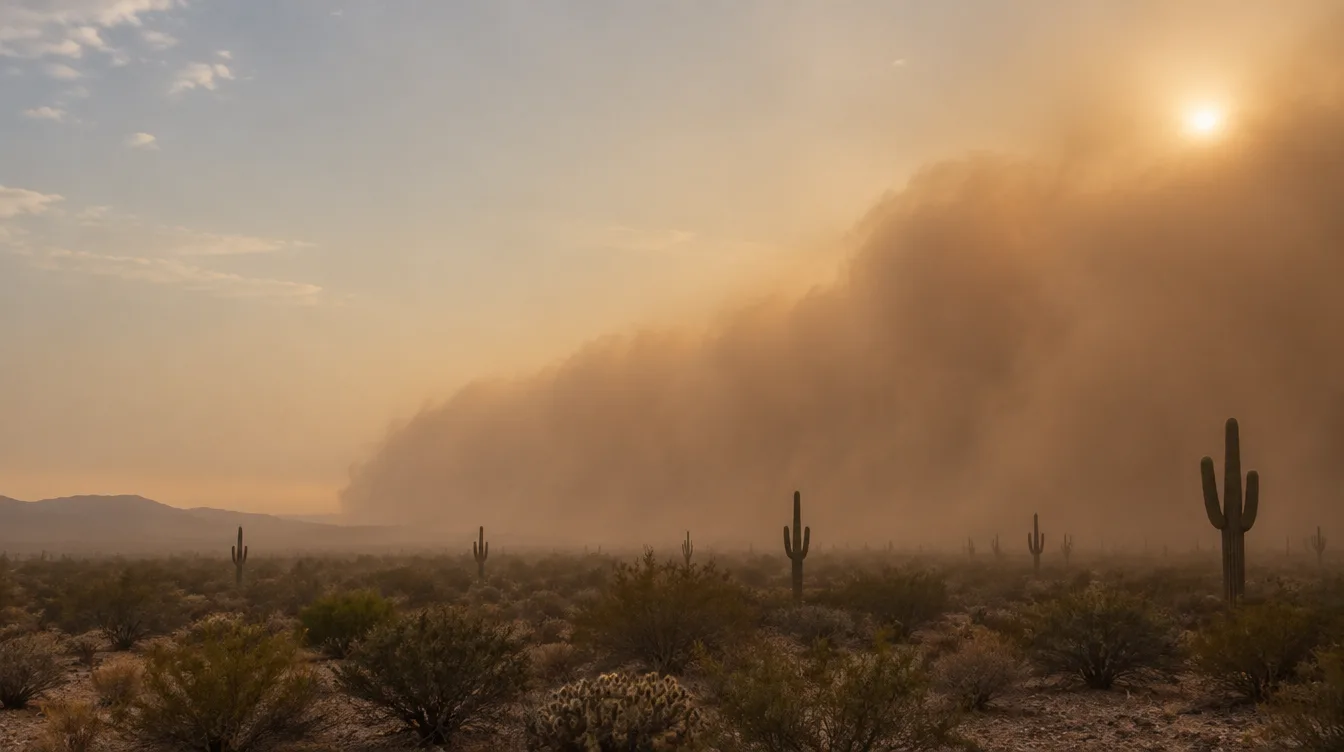
Dust — year-round, worst during monsoon. A haboob can put an enormous quantity of fine particulate into the air within minutes. The dangerous fraction is PM2.5 and PM10: particles small enough to reach deep into the lungs, and in the case of PM2.5, small enough to cross into the bloodstream. Beyond the immediate coughing and wheezing, dust events are associated with spikes in emergency visits for asthma and breathing problems.
Wildfire smoke — roughly May through September. Smoke travels hundreds of miles, so a fire in the high country or in California can degrade air here on a cloudless day. Smoke is largely PM2.5 and irritates airways, eyes, and throat; it also raises cardiovascular risk.
Ozone — late spring through summer. Formed when sunlight reacts with vehicle and industrial emissions, so it peaks on hot, still, sunny afternoons. Unlike dust, ozone is often worst in the afternoon and early evening, which is exactly when people go out to exercise once the temperature drops.
Valley fever spores — year-round, worse after soil disturbance. More on this below.
Reading the AQI
The Air Quality Index runs from 0 upwards, and the thresholds are worth knowing:
| AQI | Meaning | What to do |
|---|---|---|
| 0–50 | Good | Normal activity |
| 51–100 | Moderate | Very sensitive people may want to ease off |
| 101–150 | Unhealthy for sensitive groups | Asthma, COPD, heart disease, children, over-65s: limit outdoor exertion |
| 151–200 | Unhealthy | Everyone limits prolonged exertion outdoors |
| 201–300 | Very unhealthy | Stay indoors; sensitive groups avoid going out |
| 301+ | Hazardous | Everyone stays indoors |
Check AirNow.gov or the Maricopa County air quality department. Arizona issues High Pollution Advisories, and they are worth acting on rather than noting.
Who needs to pay attention
People with asthma or COPD. People with heart disease or a previous stroke. Children, whose airways are smaller and who breathe faster relative to body size. Adults over 65. Pregnant women. Outdoor workers. Anyone recovering from a respiratory infection.
If you are in one of those groups, treat a bad-air day like a bad-heat day: change the plan.
What to do on a bad-air day
Stay indoors and close windows and doors. Run the air conditioning on recirculate rather than drawing outside air in. A HEPA air cleaner in the room where you spend most time makes a measurable difference; so does a fresh, high-efficiency filter in your HVAC system.
Postpone outdoor exercise — during exertion you breathe far more air, and more deeply, so a run on a smoky day delivers a much larger dose than a walk.
A proper N95 or P100 respirator helps with dust and smoke if you must be out. A cloth or surgical mask does very little against fine particulate.
Avoid adding to indoor pollution: no candles, incense, wood fires, or frying with poor ventilation. Don’t vacuum without a HEPA filter — it re-suspends dust.
Keep inhalers accessible, not in a drawer, and know your asthma action plan. If you are using a rescue inhaler more than usual, that is information worth bringing to us.
Caught driving in a dust storm
This is a genuine Arizona hazard and the guidance is specific: pull aside, stay alive.
Pull completely off the roadway as far right as you safely can. Turn off all your lights, including brake lights — drivers behind you fixate on lights and will drive straight into them. Take your foot off the brake. Set the parking brake. Keep your seatbelt on and wait. Do not stop in a travel lane, and do not try to drive through with hazards on.
Valley fever, specifically
Coccidioidomycosis is a fungal infection from spores in Sonoran desert soil, and Arizona accounts for a large majority of US cases. Spores become airborne when soil is disturbed — construction, dust storms, gardening, off-road driving, digging.
Most people who inhale them have no symptoms at all. Some develop what feels like a stubborn chest infection: cough, fatigue, fever, chest pain, headache, night sweats, muscle aches, sometimes a rash on the legs or torso. The distinguishing feature is duration — weeks, not days — and the fact that antibiotics do nothing, because it is a fungus.
Higher risk of severe disease: people with weakened immune systems, those on immunosuppressive medication, pregnant women, adults over 60, people with diabetes, and some ethnic groups including people of African and Filipino descent. Newcomers are more susceptible than long-term residents, which catches out new arrivals and seasonal visitors.
Diagnosis needs a specific blood test, which will not be run unless someone thinks of it. If you have had a respiratory illness or unexplained fatigue for more than three weeks, ask us about it directly. Most cases resolve without treatment, but some need antifungal medication for months, and a small number spread beyond the lungs — which is why getting the diagnosis right matters.
Where to go
Call 911 for severe breathing difficulty, bluish lips, confusion, or chest pain.
Come to our Emergency Room — 9700 N. Saguaro Blvd, open 24 hours — for an asthma or COPD flare that a rescue inhaler is not controlling, breathlessness at rest, or chest pain. We have chest X-ray and CT in the building plus nebulised treatment and oxygen on site. ER: (602) 671-7990.
Book our Medical Clinic for a lingering cough, a Valley fever test, an asthma action plan, inhaler technique review, or spirometry. Call (602) 671-7981.
Related: shortness of breath · Arizona allergies
Sources
- AirNow — Air quality index basics
- CDC — Valley fever (coccidioidomycosis)
- Arizona Department of Transportation — Pull aside, stay alive
- Maricopa County Air Quality Department — Air quality forecasts